Everything you need to know before you begin.
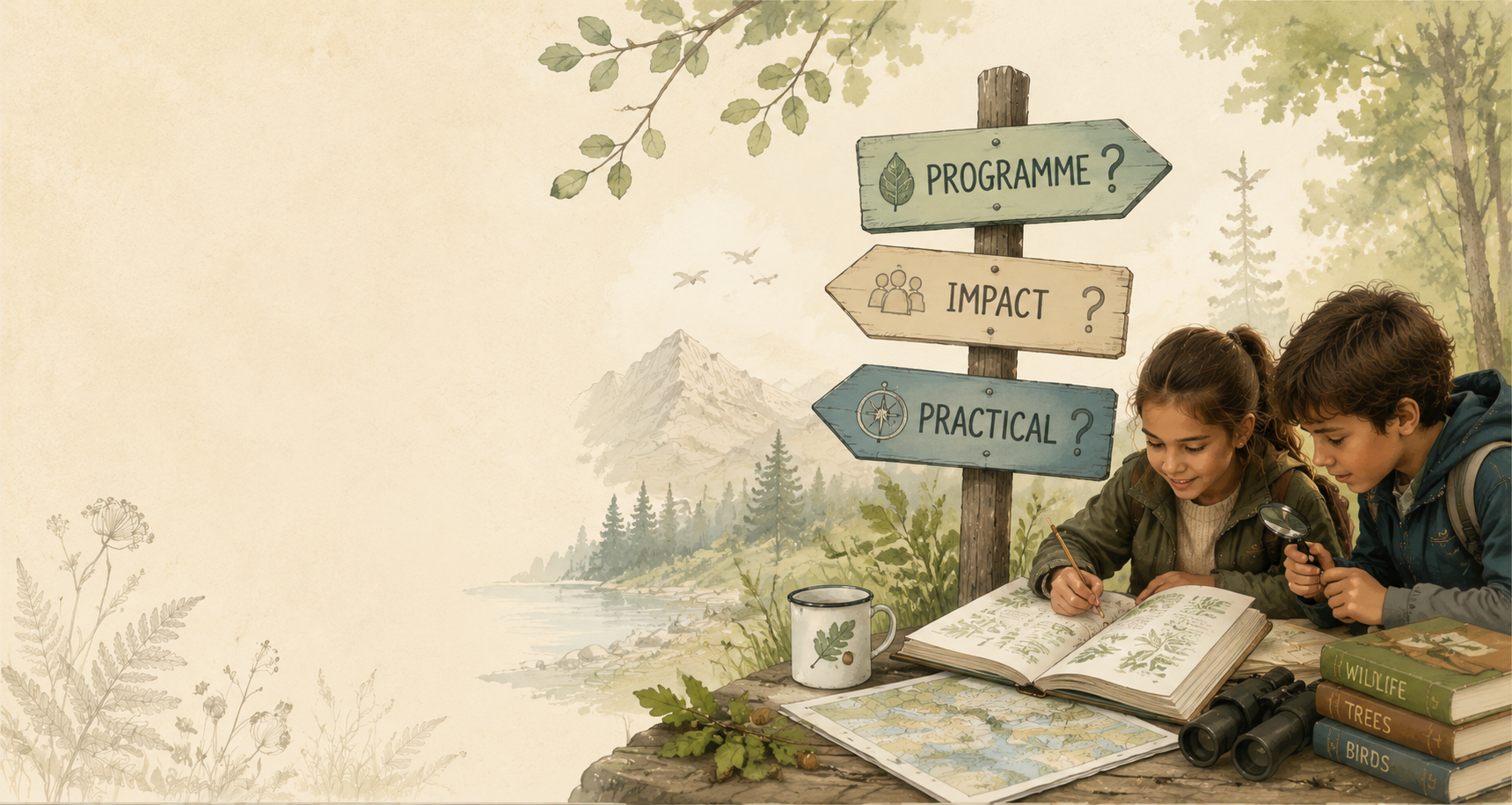
Explore how the programme works, what pupils experience and how we support educators.
About Acorn
What makes Acorn Explorers different?
Acorn doesn’t simply teach children facts. It creates structured opportunities for children to observe, question, investigate and justify their thinking.
Children become Explorers - building confidence in how they approach ideas, not just what they know.
Is it suitable for different ages and abilities?
Yes. Acorn Explorers is designed around thinking depth rather than age. Children can work at the level of challenge that best supports their confidence and independence.
Are the topics too complex for children?
Children are capable of engaging with meaningful ideas when they have the right support.
Acorn introduces real-world challenges through stories, exploration and guided discussion, helping children explore ideas without expecting them to solve the world's biggest problems.
How much teacher preparation is needed?
Each pack includes the resources needed to begin. Teachers can use missions flexibly as individual activities, connected learning sequences or part of wider topics.
Is Acorn Explorers aligned with the curriculum?
Yes. Acorn has been designed to complement existing classroom learning by providing real-world contexts where children apply and deepen their knowledge.
Missions naturally connect with areas including literacy, geography, natural sciences, life skills and creative arts..
What is the difference between Adventurer and Investigator editions?
Both editions follow the same missions and develop independent thinking.
The difference is the level of support:
Adventurer provides more guidance and confidence-building.
Investigator offers greater independence and deeper reasoning.
The best choice depends on the learner, not simply their age.
Which subjects can it support?
Missions naturally connect with science, geography, literacy, sustainability and wider curriculum learning. The focus is not simply on content - it is on developing thinking skills.
What age group is Acorn for?
Acorn Explorers is designed for children aged 7+.
Rather than focusing only on age, the programme recognises that children develop differently. Two editions allow learners to choose the level of support and independence that best suits them.
How do schools get started?
Schools can begin with a pilot, classroom trial or full programme. Contact us to discuss the approach that best fits your learners.
There is no single way for schools to use Acorn.
Schools can use Acorn for whole-class learning, small groups, individual exploration, enrichment, intervention or cross-curricular projects. Teachers can guide the journey, allow children to make choices together, or adapt missions for different groups.
Does Acorn Explorers involve marking or assessment?
Acorn Explorers is designed to develop thinking, not test children.
The focus is not on finding a single correct answer or assessing children through traditional marking. Missions are designed to encourage curiosity, reasoning, reflection and discussion, where children can explore ideas, explain their thinking and learn from different perspectives.
Teachers may choose to use children's work as part of classroom discussion, reflection or wider assessment approaches, but Acorn does not require additional marking workload. Most activities are based on open-ended questions where the focus is on depth of thinking, not right or wrong.
The goal is not to measure whether a child has reached the "right" answer.
The goal is to help children become better thinkers.
How does the choice based exploration format ("choose your own adventure") work when the whole class is exploring together?
Acorn Explorers is designed to support both individual exploration and shared classroom journeys.
When children are working independently, they can make their own choices about where their exploration takes them next, following their curiosity and interests.
When a class is exploring together, the teacher can guide the journey in a way that works best for their context.
This might include:
Teacher-guided choices
The teacher selects the next pathway based on classroom discussion, curriculum connections or what will best support upcoming learning.Class decisions
The class votes on the next direction, creating opportunities to discuss different perspectives and consider why one path might be chosen over another.Explorer choices
A pupil may be invited to choose the next step as recognition of the qualities Acorn aims to develop, such as curiosity, kindness, courage, collaboration or perseverance. The choice is not a reward for academic achievement, but a celebration of character and contribution.
The important thing is that choice remains meaningful. Children learn that decisions have consequences, different perspectives matter and there is rarely only one way forward.
Taking Acorn into the classroom
Should schools use the Field Journals as books, or individual missions?
Acorn Explorers missions can be experienced in different formats depending on how your school, learners and families prefer to engage with them.
Field Journal format
Many schools choose the Field Journal format because it keeps the learning journey together. Children can see their progress, revisit previous thinking and build a personal record of their exploration.
The choice based exploration approach (similar to Choose Your Own Adventure) still works beautifully within the Field Journal format, allowing learners to make meaningful choices about where their exploration takes them next while maintaining a shared journey.Individual mission format
Individual mission sheets provide greater flexibility for schools and families who want to select specific missions, share children's work more easily or celebrate individual achievements.
For some children, completing a mission they are proud of and displaying it at home, sharing it with family or discussing it with others becomes an important part of the learning experience.
In classroom environments, some educators prefer the Field Journal format because it keeps children's exploration organised and provides a clear record of their journey over time.
Both formats contain the same Acorn learning experience, they simply offer different ways for children and schools to engage.
What happens when children complete a Field Journal? Is Acorn a one-off experience or an ongoing programme?
Acorn Explorers can work in different ways depending on what a school is looking to achieve.
Some schools may choose a single Field Journal as a focused experience, for example, as a transition journey when children are preparing to move between schools, an enrichment project, or an introduction to the Acorn approach.
Other schools may choose to build Acorn into a longer-term learning journey, where children continue exploring through additional Field Journals and new missions.
The value of Acorn is not simply in completing more missions. It is in how children's thinking develops over time. A mission explored again a year later can create a completely different experience because the learner has changed, their knowledge, confidence, perspectives and ability to make connections have grown.
Each journey helps strengthen the thinking habits that Acorn develops: curiosity, confidence, reflection, reasoning and connection.
Acorn grows with the learner.
Do children move from Emerging Thinkers to Confident Thinkers over time?
Are the thinking pathways like levels that children progress through?
No. The Acorn thinking pathways are not designed as a sequence of levels that children complete and then move beyond.
Emerging Thinkers and Confident Thinkers represent different ways of engaging with exploration, challenge and reflection. They are designed to support children at their current stage of thinking, rather than define what they are capable of based on age or year group.
A child's pathway is not a label or a judgement. It is a way of ensuring that every learner experiences meaningful challenge, builds confidence and develops as a thinker.
As children's confidence, experience and independence grow, they may naturally move towards different levels of challenge — but this happens through developing their thinking, not by simply completing one pathway and moving to the next.
Acorn grows with the learner.
Can children in the same class use different thinking pathways? Do all children in a class need to complete the same version?
No. Acorn Explorers is designed to support different learners within the same shared experience. We don't ask "What level is this child?" but rather "How do we help this child think more deeply?"
Children in the same class may engage with missions at different depths depending on their confidence, experience, independence and current thinking needs.
This does not mean children are separated into fixed groups or identified by ability. Instead, it allows every child to participate in the same exploration while receiving the level of challenge and support that helps them grow.
Many educators already use similar approaches across classroom learning, where children may explore the same topic while responding, reasoning and creating at different levels of depth.
Same mission. Different depth. The whole class shares:
the same mission;
the same theme;
the same real-world context;
the same discussions.
The difference is in:
scaffolding;
independence;
complexity of reflection;
depth of reasoning.
Questions Schools Often Ask
What makes Acorn Explorers different?
Acorn doesn’t simply teach children facts. It creates structured opportunities for children to observe, question, investigate and justify their thinking.
Children become Explorers - building confidence in how they approach ideas, not just what they know.
Is it suitable for different ages and abilities?
Yes. Acorn Explorers is designed around thinking depth rather than age. Children can work at the level of challenge that best supports their confidence and independence.
How can schools use Acorn Explorers?
There is no single way to use Acorn.
Schools can use Acorn for whole-class learning, small groups, individual exploration, enrichment, intervention or cross-curricular projects. The programme is designed to fit around schools rather than requiring schools to fit around it.
Are the topics too complex for children?
Children are capable of engaging with meaningful ideas when they have the right support.
Acorn introduces real-world challenges through stories, exploration and guided discussion, helping children explore ideas without expecting them to solve the world's biggest problems.
How much teacher preparation is needed?
Each pack includes the resources needed to begin. Teachers can use missions flexibly as individual activities, connected learning sequences or part of wider topics.
Is Acorn Explorers aligned with the curriculum?
Yes. Acorn has been designed to complement existing classroom learning by providing real-world contexts where children apply and deepen their knowledge.
Missions naturally connect with areas including literacy, geography, natural sciences, life skills and creative arts..
What is the difference between Adventurer and Investigator editions?
Both editions follow the same missions and develop independent thinking.
The difference is the level of support:
Adventurer provides more guidance and confidence-building.
Investigator offers greater independence and deeper reasoning.
The best choice depends on the learner, not simply their age.
Which subjects can it support?
Missions naturally connect with science, geography, literacy, sustainability and wider curriculum learning. The focus is not simply on content - it is on developing thinking skills.
What age group is Acorn for?
Acorn Explorers is designed for children aged 7+.
Rather than focusing only on age, the programme recognises that children develop differently. Two editions allow learners to choose the level of support and independence that best suits them.
Can it be used with a whole class?
Yes. Missions can be completed individually, in groups or as a whole class. Teachers can guide the journey, allow children to make choices together, or adapt missions for different groups.
How do schools get started?
Schools can begin with a pilot, classroom trial or full programme. Contact us to discuss the approach that best fits your learners.
Explore
hello@acornstudiopress.com
+44 7356 234765
© 2026 Acorn Studio Press Ltd. All rights reserved.
Connect
Follow us
Learn
Legal
Proudly registered in the UK as Acorn Studio Press Ltd. Company No. 16717513
Registered Office: Unit A, 82 James Carter Road, Mildenhall Industrial Estate, Suffolk, IP28 7DE
hello@acornstudiopress.com